

By Connie Oswald Stofko
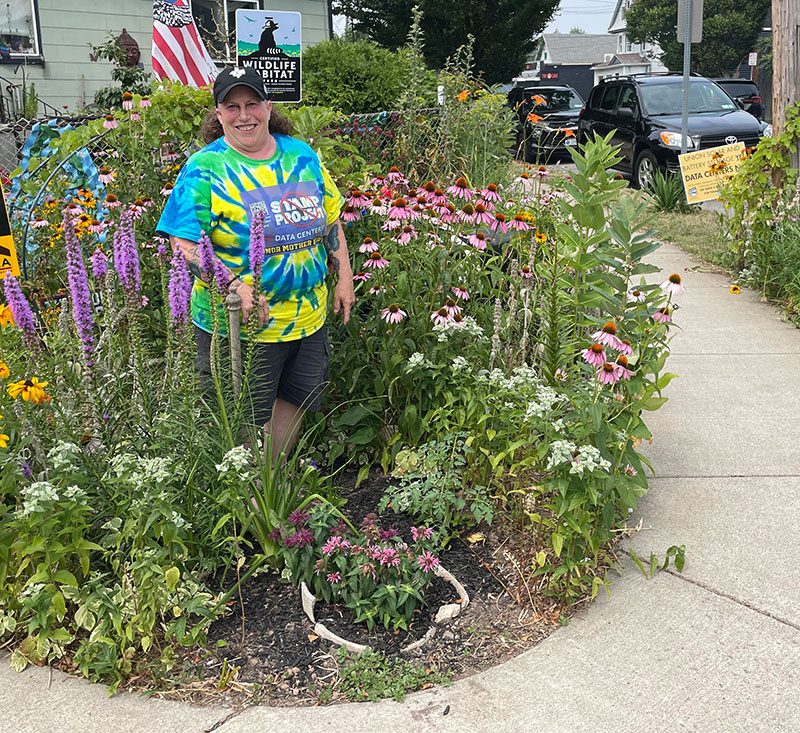
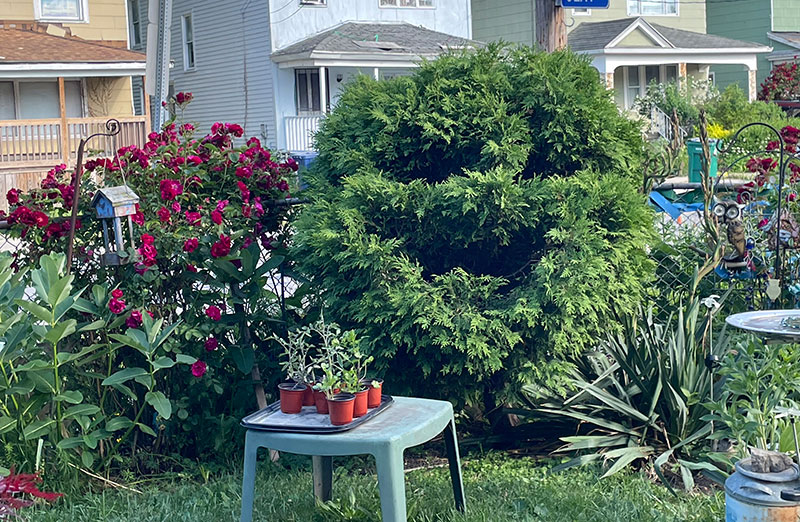
“I started out with just grass,” said Eve Wackett as she surveyed her small—but packed!—gardens in the Black Rock neighborhood of Buffalo.
“There was nothing when I moved in in August 2019. The landlord said I could do what I wanted garden-wise.”
And she took off!
“Over the last seven years, I’ve been adding some plants, moving stuff,” Wackett said. “Now it’s mostly perennials, so I don’t have to do much.”
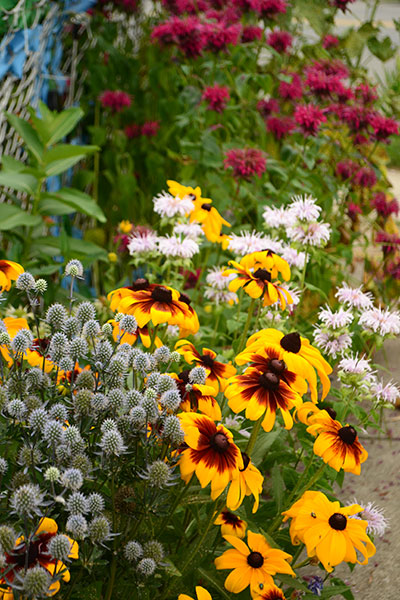
If there’s a blank space, she adds some annuals. “But I don’t need to add any this year. I think I have too much going on!” she said with her spirited laugh.
The first area that people see is the half-circle garden outside the fenced-in yard.
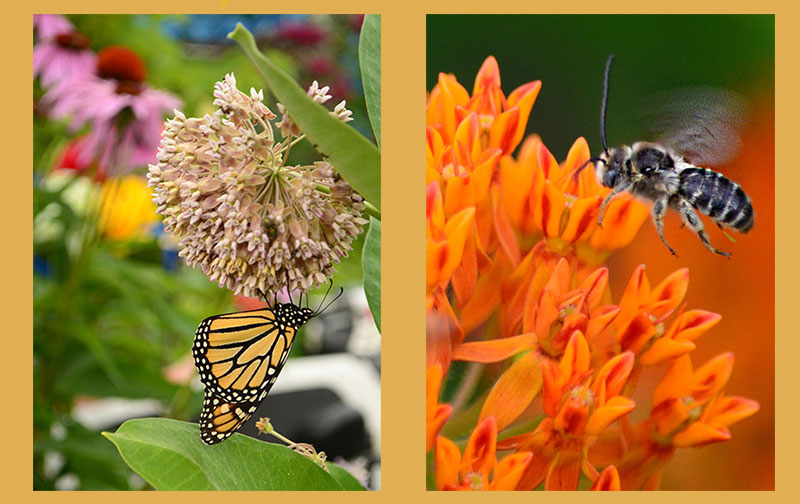
As we chatted, a little girl pedaled down the sidewalk on her bike and pointed to Wackett’s garden. “Look–a butterfly. Two white ones!” A moment later she noticed a monarch. “I saw one of those yesterday!” she added.
As Wackett showed me around, she stopped at a Virginia mountain mint, plucked a leaf, and sniffed.
“I just love this because it smells so… mmm,” she said. “It’s very aromatic and it attracts a lot of pollinators.
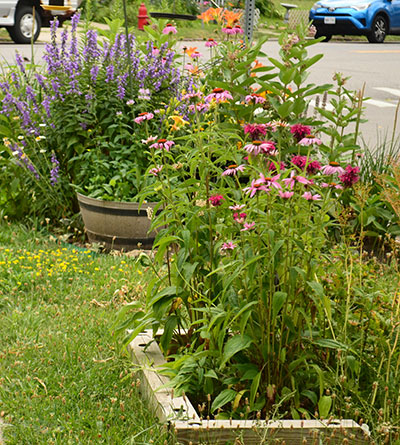
“That’s been my main things—things that will attract butterflies and hummingbirds. It took me about three years, but I get hummingbirds every year now. I thought I wasn’t going to get them in the city, especially on Military Road being so busy, but I was so excited when I saw the first ones!”
Plants that attract pollinators in Wackett’s gardens include coneflowers, gloriosa daisy, cardinal flower, six colors of monarda (bee balm), sunflowers, blanket flower (Gaillardia), lupine (pink and blue), sea holly, and meadowsweet. She also has three kinds of milkweed: common milkweed (Asclepias syriaca), swamp milkweed (Asclepias incarnata) and butterfly weed or orange milkweed (Asclepias tuberosa). Sometimes she harvests the eggs and releases the monarchs.
Tip on pollinators: Use goldenrod and asters for autumn. “Late in the season, the bees might need it for food,” Wackett said. “When you go out in a field, and you see the asters and goldenrod together, it’s just so beautiful. And the insects and flowers depend on each other.”
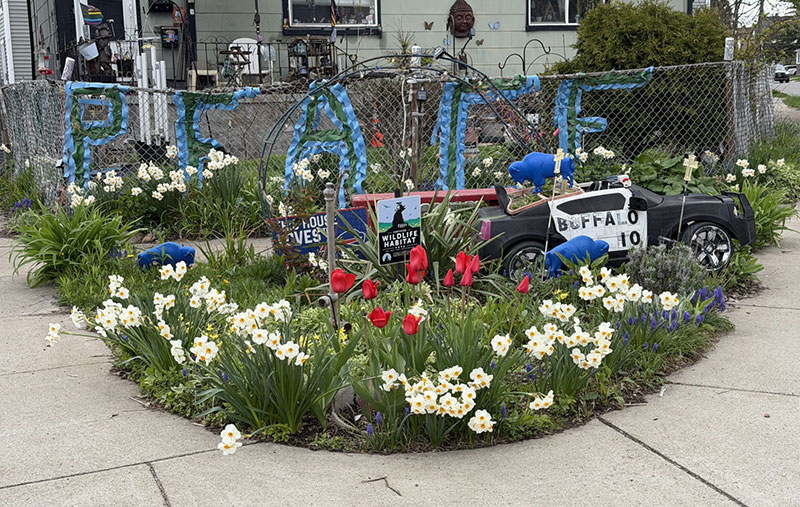
The half-circle garden is important in another aspect. That’s where Wackett designed a memorial to 5/14, the day in 2022 when 10 people were killed by hate. On the fence, large letters spell out “peace.” The small Buffalo police car is a reminder of Aaron Salter Jr., a former Buffalo Police lieutenant who was working as a security guard, as well as the others who were also fatally shot: Celestine Chaney, Roberta A. Drury, Andre Mackneil, Katherine Massey, Margus D. Morrison, Heyward Patterson, Geraldine Talley, Ruth Whitfield, and Pearl Young.
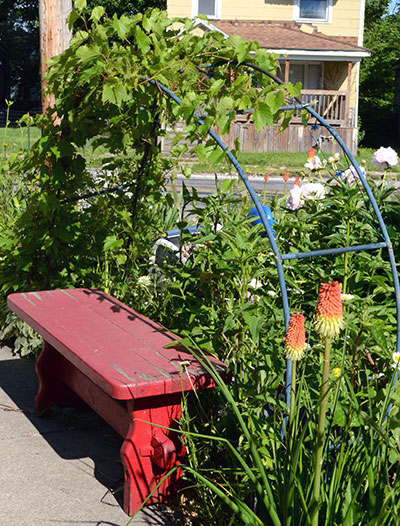
At the back of the half-circle, a trellis supports a grape vine.
“I like to pick the grape leaves,” Wackett said. “Growing up, my mom and our family would just go along Route 104 and all of the vines would be growing and we would go out and pick all the wild grape leaves.”
Her father was Syrian, and her paternal grandmother helped Wackett’s mother learn how to carry on the Syrian traditions.
“My mom would clean the leaves and freeze them, then stack them in packages of fifty to a hundred. Then when you were ready to make grape leaves, you pull them out and thaw them. You make a mixture of hamburger, rice, mint, and onion in the leaf. My mother used to make this thing called lubin with yogurt and sour milk. I thought it was weird but I loved this stuff.”
The grapevine is a wonderful addition to her garden, but she didn’t plant it. It is one of the many “volunteer” plants that have found a spot in her small landscape.
The small fenced-in yard contains a vegetable garden. Wackett plants heirloom tomatoes—green zebra, Cherokee purple, and indigo cherry—and she saves the seeds to plant in the next year’s crop. She plants garlic every year, using cloves from the previous batch. Other edible plants include sweet peppers and cilantro.
There are shrubs including dogwood, crabapple, Washington hawthorn, lilac, and Japanese maple. Flowers line the fence outside as well as inside. A compost bin is squeezed in. There’s even some lawn.
Beyond gardening, Wackett is active with many environmental organizations, including Believe in Black Rock Block Club, the Clean Air Coalition of WNY (CACWNY), Allies of the Tonawanda Seneca Nation, WNY Environmental Alliance Rights of Nature, Food and Water Watch, and Buffalo Niagara Waterkeeper.
Wackett also has a New York State license as a wildlife rehabilitator. As a volunteer at the Erie County SPCA, she has been able to feed a bald eagle, released a bufflehead duck in winter, and helped an abundance of turtles that have been injured crossing roads.
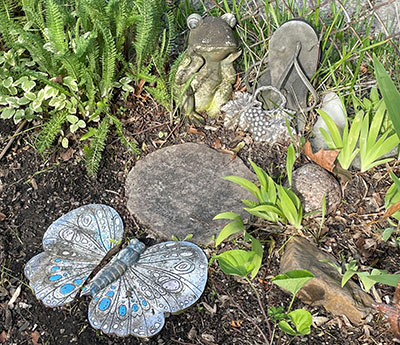
The last part of her garden tour was a second memorial. This one was personal.
From 2012 to 2015, Wackett had gone through several agonizing losses. Her best buddy died. Her mother died from cancer. Her nephew died of suicide. Then her sister was found deceased in her running vehicle. It was reported as carbon monoxide poisoning, but Wackett said that doesn’t make sense to her.
“During that whole stretch, I was going through a lot of grieving, so I made this as the memorial spot for my sister and everyone else,” she said.
The memorial includes a few items that remind Wackett of her loved ones. A flat stone has an inscription: “No farewell words were spoken, no time to say goodbye, you were gone before we knew it and only God knows why.”
“That was the beginning of a rebirth of myself,” she said. “All of that grieving was spent.”
She joined Unity of Buffalo church. And she got into gardening.
“The gardening brings me peace,” she said.
“I could be angry and upset about something and I come out here and get my hands in the dirt, and no matter how it hurts my body physically, it helps me mentally and emotionally. I can’t even put a word on it to describe that feeling.”
Wackett paused. “I’ll call it healing.”
Her landlord is selling the house and Wackett may have to move. If she moves, she might not have a garden. But for now, she tends to the plants.
“Getting my hands in the dirt helps heal the pain,” Wackett said.
Connie Oswald Stofko created the Buffalo-NiagaraGardening.com magazine in 2010.


We’re glad you’re reading, Lynne!
So glad to see this newsletter pop up in my inbox again!