

By Peggy Koppmann
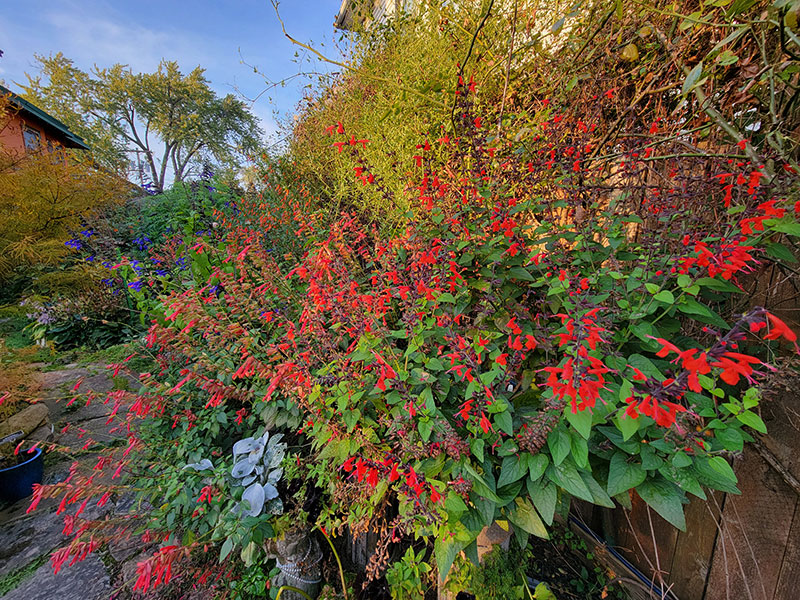
November brings a shift to colder, darker nights and the last of the (outdoor) gardening chores. We put away hoses and summer furniture, finish planting spring bulbs, mow one last time, and hang up our rakes after the last stubborn leaf has fallen. If we are lucky, we might get to enjoy ‘Indian Summer,’ that period of abnormally warm weather that comes after a killing frost. Those glorious days of brilliant sunshine illuminate our fading gardens and give us hope for the next season.
Sunscreen for trees??

Winter sunlight can heat up the bark and the underlying layer of cambium on the south and southwest side of young trees. Cells in the bark and cambium are warmed up by the sun and become active, then are killed when the temperature drops at night. When the cambium layer dies, the bark over it dies, loosens, and falls off. Discoloration and cracking of the bark are most common on fruit trees, thin-barked ornamentals and trees newly planted in full sun.
November is a good time to apply white tree wrap which reflects light away from the trunk, but be sure to remove it in the spring.
Missouri Botanical Gardens has an excellent article on ‘Sunscald of Woody Plants’ with additional information on prevention.
Winter weeds
You may think you’ve wrapped up the gardening season, but there is one chore that you can continue as long as the weather permits, weeding! Annual winter weeds germinate in the fall, grow slowly during the winter, and pop up to plague you in the spring.
Think henbit, deadnettle, chickweed, wild mustard, horseweed, prickly lettuce, annual bluegrass, shepherd’s purse, horseweed. The names may be unfamiliar, but chances are they’ll all show up in your garden along with (too) many others.
Start a winter project to learn to identify at least 10 common annual and perennial weeds and their names.
UMass has an excellent site to begin.
While you’re at it, add this resource to your gardening library: Weeds of the Northeast by Neal, Uva, DiTomaso and DiTommaso (Cornell Univ. Press, 2023).

Herb advice from Paul and Art
You remember, “parsley, sage, rosemary, and thyme.” It turns out, you can enjoy fresh herbs all winter—if you have enough sunlight to keep them going. An extra-deep windowsill or table next to the window will capture the best light. You’ll have to water, fertilize, and keep an eye out for hitchhikers, especially aphids. Protect plants from cold windows during the depths of winter.
Parsley is a biennial and may even survive outside, sending up stalks in late winter. Rosemary needs a large pot and constant monitoring for watering; the needle-like leaves don’t wilt. Sage and thyme benefit from being left outside to experience some cold weather before you bring them in around Thanksgiving. The serious herbalist might also invest in a lighting system to overwinter plants successfully.
Here’s a place at The Spruce to start your research: 16 Herbs to Grow Indoors.
Mischler’s in Williamsville (and perhaps other late-season garden centers) is still selling select herbs.
Mulching misdeeds
There are lots of good reasons to apply mulch after the first hard frost. A layer of mulch helps moderate soil temperature, reduce heaving, protect from very cold temperatures, keep plants dormant, and reduce erosion and soil compaction. At the same time, if it is laid down too early, mulch may keep the soil warm and moist for too long, increasing the possibility of disease.
- Don’t bury plants in mulch more than 2-3 inches deep; more can keep water and oxygen from plant roots.
- Don’t bury plant crowns or basal rosettes.
- Keep mulch at least 6 to 10 inches away from the base of woody plants.
- Good winter mulches include straw, hay, pine needles, and partially decomposed bark or wood chips to allow for airflow through the mulch.
Take a deeper dive here, via Proven Winners.
Beyond black spot
Most gardeners have experienced the question of “What’s wrong with my plant?” We can identify black spot or powdery mildew, but that may be the limit of our diagnostic skills. The long, cold days ahead of us present the perfect opportunity to learn more about plant diseases, proper diagnosis, and management techniques.
Whether it’s fungal, bacterial, viral, or environmental, learning how to identify and manage plant diseases is a step toward protecting what we have created in our gardens, yards, and property.
Start with this wonderful article by Margaret Roach. Then take a look at The National Plant Diagnostic Network and bookmark the website of the Purdue Plant Doctor.
By next year, you’ll be “The Plant Detective.”
And then…
Clean up any remaining diseased material from around roses; clean and sharpen tools; drain and store hoses and nozzles; provide water for the birds; protect shrubs with deer netting; turn the compost pile before it freezes; reduce watering frequency for house plants; install rabbit and rodent guards around trees; jot down notes about the gardening season before you forget; pot up paperwhites and other spring bulbs for forcing; harvest leeks, parsnips and kale; scout for tent caterpillars; give thanks for the joy and satisfaction of being a gardener.
Peggy Koppmann is an Erie County Cornell Cooperative Extension Master Gardener Volunteer and a longtime contributor to CCE Erie’s newsletter, Gardening Matters (and to this website).
