

By Laurie Ousley
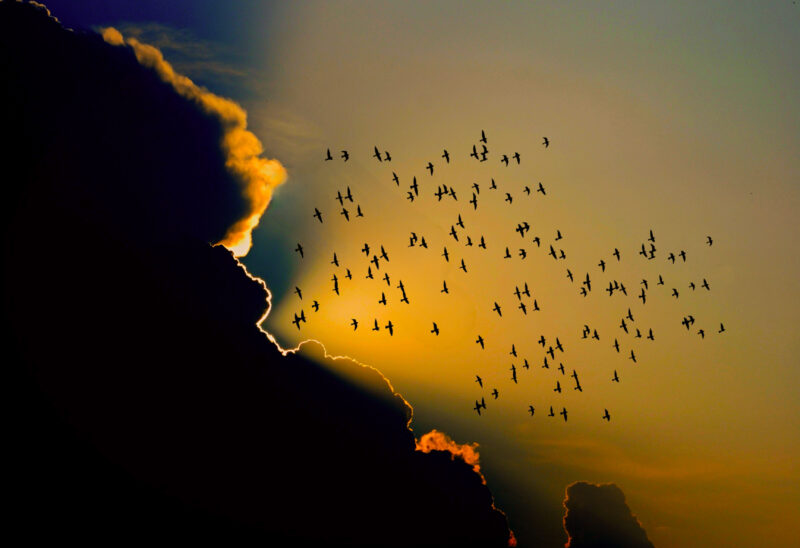
Right now, millions of birds are travelling through our skies on their autumn migration.
Western New York is part of the Atlantic Flyway, a significant migration pathway, and the Niagara River Corridor is a Globally Significant Important Bird and Biodiversity Area, connecting the Great Lakes Region’s bird migration to the Atlantic Ocean.
Jay Burney, a longtime, tireless advocate for birds and local ecology, said, “This international designation puts our region on a par with places like the Galapagos, the Florida Everglades, Yellowstone, and the Grand Canyon.
“We have incredible breeding and migration populations of many species of birds that depend on our area for survival year round.,” Burney said. “We have some of the most abundant populations of winter birds on the Niagara River because it has open water.”
Dark skies matter
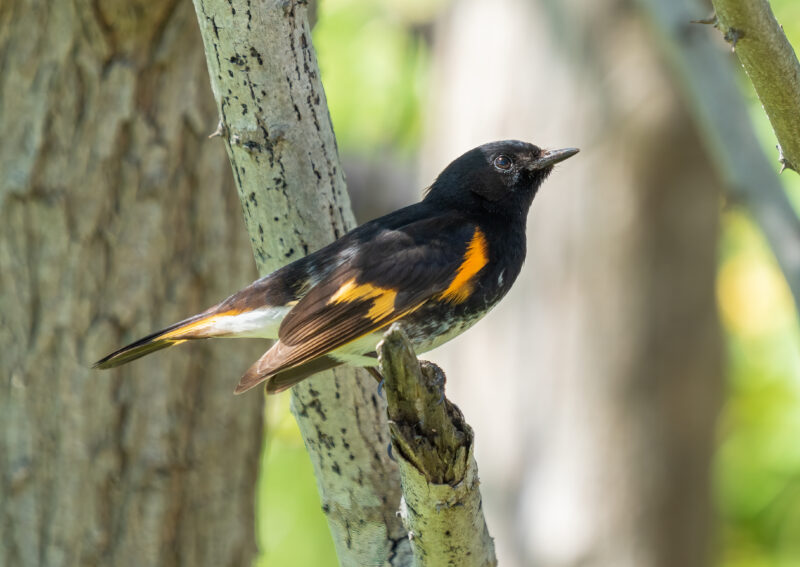
I don’t think that I’m alone in associating the sight of geese with the seasonal migrations, but about 80 percent of birds actually migrate at night. Millions of birds begin their journeys just after dusk, and on good nights some continue until just before dawn.
How many millions? The night of September 25 alone, an estimated 3, 226,500 birds flew over Erie County!
Flying by night makes this journey safer for a number of reasons, including the stillness, cooler temperatures, and fewer predators.
The night sky is a place of dynamic, remarkable activity, but because this migration happens in the dark while most of us are asleep, we can’t see it for ourselves. Scientists have now developed migration tools that allow us to actually see birds’ airborne behavior for ourselves and allow ornithologists to study it.
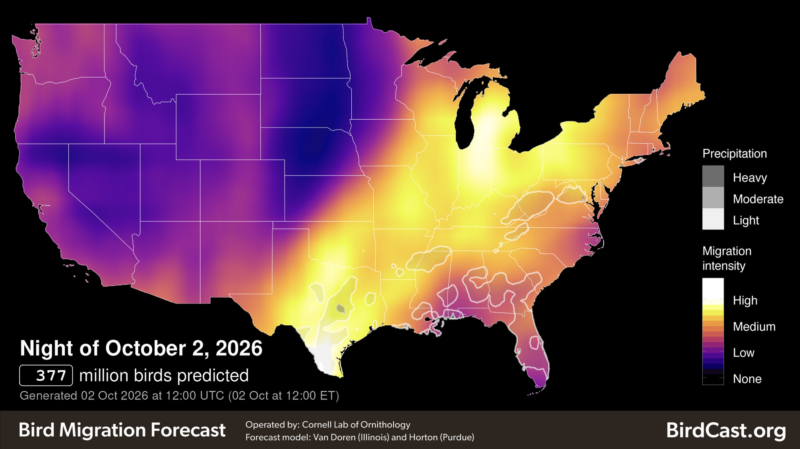
The Cornell Lab of Ornithology has developed BirdCast, a free online tool that uses weather radar to track and study these seasonal migrations, and it is amazing. BirdCast allows us to see this phenomena in a way that allows us to begin to grasp just how astonishing it really is.
The tool’s Live Migration Maps show actual nocturnal migration as it is detected by the radar network. This technology can tell us about the intensity, direction, speed and altitude of migration—information that would be nearly impossible to gather simply by standing outside and looking up.
BirdCast’s Migration Forecast Maps also predict where migration is expected to be intense–where birds will be in active flight.
These tools let us explore migration at a much more local level, as well, including a focus on the skies of individual counties. You can look at what is happening overhead, explore migration on different nights, and compare what you’re seeing with previous seasons.
“Lights Out” for birds
Once you’ve seen the sheer numbers, you naturally start to marvel at how birds actually accomplish this journey, despite what stands in their way.
We’ve learned that birds that migrate nocturnally navigate with celestial guidance using the stars and planets. We’ve therefore also learned that artificial light can attract and disorient migrating birds, drawing them away from their natural routes and toward buildings and other hazards. Cornell researchers have documented how artificial light can alter nocturnal migration behavior.
The necessity of preserving dark skies in order to assist in preserving their safety has become imperative, as we are witnessing the decline in bird populations due to habitat loss, human interventions (agricultural practices, herbicides and pesticides, buildings, our cats), and environmental pressures such as climate change. An estimated 45-51 percent of global migratory bird species are in decline and about 11 percent of migratory birds are threatened with extinction.
Burney asserts, “One of our most important conservation strategies that we can adopt for our region is ‘lights out’ for birds, especially during spring and fall migration.”
The BirdCast project has become an important tool for understanding when birds are moving through our communities, and this gives us a very easy and effective way to assist them: turning out the lights and leaving them a dark sky in which to travel.
Turning off or minimizing unnecessary outdoor lights during migration can make a difference and this has initiated the founding of the dark skies movement.
Watch Jay Burney’s video below to learn more about dark skies and the role our region plays in global bird migration:
Laurie Ousley is a life-long gardener and has proudly served as the President of Gardens Buffalo Niagara for several years.
