

Beetle traps, black paint, and other brilliant backyard hacks
Story and photos by Jim Charlier
I’ve learned a great deal from visiting gardens, and the best way to do that is on a garden tour. Here are hints and advice from Open Gardens gardeners—some of the region’s most knowledgeable and generous green thumbs.
Here’s my own tip, which I borrowed from Master Gardener Sally Cunningham: bright yellow Japanese beetle traps work so well that they can attract more beetles to your garden. Your best option may be to buy one—and give it to your neighbor!
Splash and stash
“When putting in a new plant, position it to your liking in the newly dug hole, add just enough soil to hold it, then fill the hole with water and let it absorb before adding back the rest of the dirt. Keeps the ground below the plant moist for a few days and helps the plant establish a good root system.”
– Pam Rose, Parkside, Buffalo
Floppy perennials
“To manage garden floppers, do the ‘Chelsea Chop,’ cutting back the perennial by about l/3-l/2 in mid- to late-June for a compact growth habit.”
– Emma Hahn, Graycliff Head Gardener, Derby
Bigger is better!
“One trick is that larger containers (18”-plus) are easier to maintain and create more impact in the garden. More soil means more moisture, which means easier care and better results.”
– Jeff & Wendy Leyonmark, Hamburg
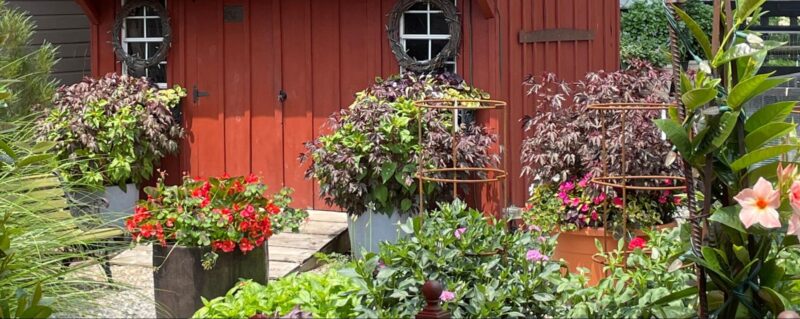
Unifying plant pots with a stroke of color
“My garden includes pots of varying sizes. Almost all are plastic or fiberglass pots I picked up from my local Buy Nothing group or found on the curb on garbage day. I upcycle the pots using black spray paint made for outdoor plastic furniture. Each spring, I refresh the pots with a good cleaning and a fresh coat of paint. The black paint helps create a unified look and keeps the focus on the plants rather than my mismatched pots.”
– Shirley Verrico, Williamsville
Nurturing native gardens
“It’s a good idea not to ‘cultivate’ too much—loose soil invites unintended plants. But sometimes an unintended plant turns out to be a valuable addition. In a native-oriented garden, when an unknown plant appears, it‘s good to see what it becomes. It has likely chosen a suitable location for itself, and as the gardener, you must guide the evolution of the garden.”
– Joe Atkinson, Amherst
Shield shrubs from snowy-season snacking
“Deep snow allowed rabbits to eat the low branches on my fruit trees. A visitor suggested wrapping the trunk and low branches in aluminum foil to protect them. This works great with espalier fruit trees and small multi-trunk trees that traditional protectors don’t fit well around.”
– Martin Skierczynski, West Seneca
For bountiful and beautiful baskets
“Keep birds from nesting in your hanging baskets—place a fake (toy) snake in the basket, and the birds will stay away!”
– Michele Setzer, Marilla
Feed the garden nutritiously
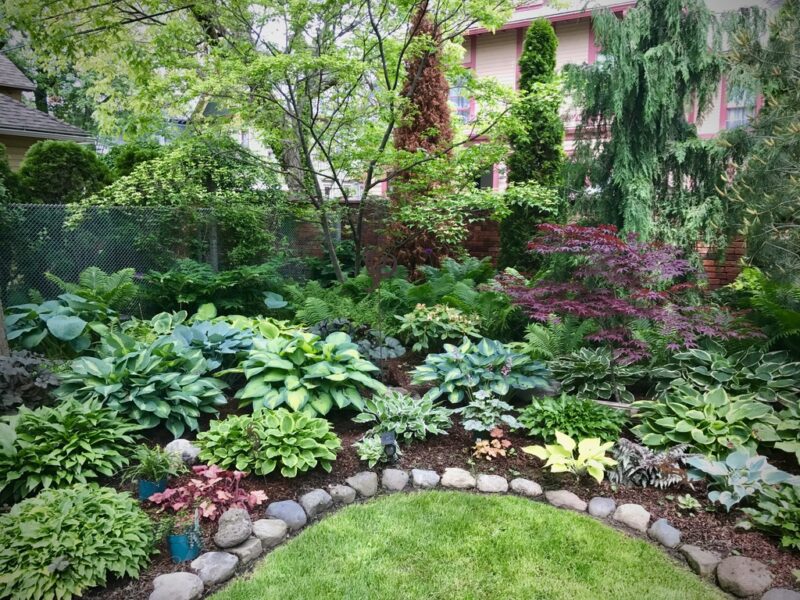
“My garden, bushes, and trees are fed with Milorganite on Mother’s Day and Thanksgiving Day. I use cocoa shell mulch. I add a 1-2 inch layer in early spring, then supplement during the season. Besides the nice smell, the shells break down to a fertilizer particularly good for hostas. Cocoa shells are not cheap, and you can’t get them everywhere (I get mine at Bill Weber’s Greenhouse and Farm Market). The result is large, happy hostas and (bonus) slugs hate it. I see 1-2 slugs a year, which is tolerable while avoiding poisons.”
– Stephen Bellus, Elmwood Village, Buffalo
Enjoy the process
“Choose perennials and annuals that thrive in your garden, and use them generously. My favorite perennial is heuchera (coral bells), for its colorful foliage, suitability for both containers and garden beds, and appeal to hummingbirds. My favorite annual is creeping Jenny. Though sold as an annual, it behaves like a perennial, both in the ground and in containers.”
– Karen Deutschlander, Lancaster
Open Gardens, in its 16th year, features nearly 90 gardens across Erie and Niagara Counties on Thursdays and Fridays in July. Visit OpenGardensWNY.com to learn more and see which garden centers sell the guides ($20) or to purchase one online.
Jim Charlier is co-author of Harry Potter, Herbology Magic (Insight Editions, 2023) and Buffalo Style Gardens (St. Lynn’s Press, 2019). He is a speaker on garden tourism and design, a member of GardenComm International, and a longtime garden blogger at ArtofGardening.org. He is a co-founder and former VP of Gardens Buffalo Niagara (GBN), chair of GBN’s Garden Art Sale, and a past president of Garden Walk Buffalo. His photography has appeared in dozens of garden magazines and books.
