

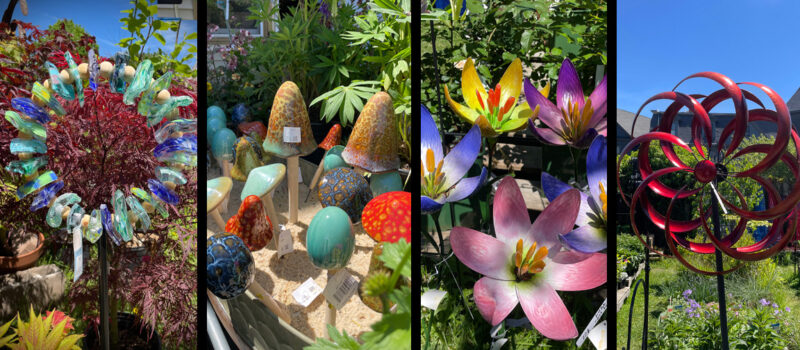
Story and photos by Jim Charlier
Does your garden need art? There are many world-class gardens, and gardens on local tours, with no garden art, and they don’t seem lacking. However, here are some reasons why you may want art in your garden:
Creates a focal point. Where the eyes go, the feet follow. Even if it doesn’t lead the feet, it gives a destination for your eyes. Maybe they’ll skim over areas of a garden you want skipped over!
Provides year-round interest. In Western New York, we garden intensely from May to September. It’s good to have something to look at from October through April. Just make sure your art is weather-proof.
Patti Jablonski-Dopkins, general manager of Urban Roots Cooperative Garden Market, says, “We select pieces of quality that will last. If you fall in love with a piece, you want it to last more than one season.” She goes on, “Wall art is popular—it can change a dead space into something that complements the garden and most pieces can be left up year-round.”
“Art can change a problem spot into a place of interest with little to no effort.” —Patti Jablonski-Dopkins
Expresses your personality. Your garden should reflect your interests, personality, or favorite. Art that means something to you, is created by you (or someone you know), or represents something meaningful to you will make your garden uniquely yours and not like any others.
Defines spaces and creates structure. Art can help define zones in your garden and help guide visitors through a space. It can also get those eyes lifted by using vertical and differing height artwork on fences and the sides of your home.
Creates sound and/or movement. Wind chimes and spinners provide pleasant sounds and motion that plants cannot.
Solves design challenges. Got a spot where plants struggle? Need to distract or disguise an unsightly view (utility boxes, trash cans, composter, etc.)? Art can add interest to spaces with limited planting areas, like tiny yards, balconies, and patios. Jablonski-Dopkins says, “It can change a problem spot into a place of interest with little to no effort.” Art also adds “instant gratification” for new garden beds and trees.
Invites wildlife. Birdbaths, feeders, and bee houses attract pollinators and wildlife. Supporting the ecosystem is especially important in urban settings. Jablonski-Dopkins says, “The importance of supporting wildlife has people considering birdbaths and fountains as artful options. They bring color and shape to a space while supporting wildlife. That’s a win/win.”
Extends your enjoyment of the garden. Lighting your garden and its artwork lets you enjoy the space for more hours each day.
Celebrates your culture and heritage. Incorporate cultural symbols, traditions, or art styles to honor family heritage or regional identity.
While your garden can be beautiful with plants alone, garden art transforms a lovely garden into a memorable one. It can add layers of meaning, personality, and sensory richness that plants—no matter how gorgeous—can’t do on their own. Garden art makes your space feel complete, intentional, and uniquely reflective of your vision and spirit.
Most garden centers have a large selection of artwork, both local and mass produced. Here are some alternate places to look for garden art:
- Gardens Buffalo Niagara’s Garden Art Sale in partnership with the Buffalo and Erie County Botanical Gardens on the front lawn, June 27 & 28. Full disclosure, this writer is the chair of the event!
- “Plantasia Garden & Landscape Show, held annually in March, has a huge selection of vendors offering just about everything you can imagine. I’d say it’s the best event in our area for finding garden art.” (Joan Mariea, East Concord)
- The Roycroft Gift Shop (Cindy Kincaide, Buffalo)
- “Reuse Action for cast iron, stone, terra cotta, bricks, and wooden architectural pieces.” (Edmund Haremski, Buffalo)
- “Antique World, especially when they have the Great American Garage Sale. I loved finding items there to repurpose for my garden.” (Nancy Cardillo, Rochester)
- “I always keep an eye open at yard sales and even people’s ‘discards’ at the curb.” (Penny McKenna, Buffalo)
- “The Junior League Decorator’s Showhouse” (Valerie Priester, Buffalo)
- “Estate sale basements and garages.” (Deborah Lynn Williams, Buffalo)
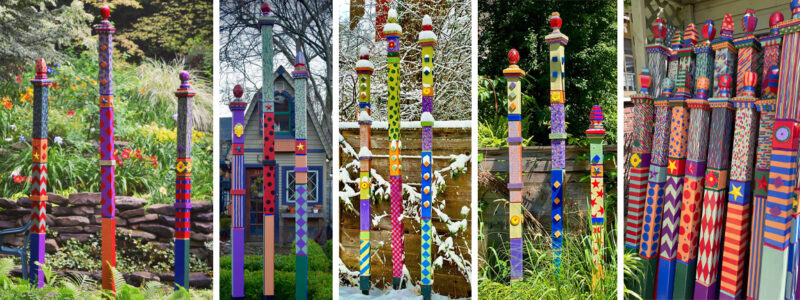
Jim Charlier is a self-employed graphic artist (JCharlier.Design) who also makes and sells garden art posts. He is co-author of Harry Potter, Herbology Magic (Insight Editions, 2023) and Buffalo Style Gardens (St. Lynn’s Press, 2019). Jim is a speaker on garden tourism and design, a member of GardenComm International, and a longtime garden blogger at ArtofGardening.org. A co-founder and former vice president of Gardens Buffalo Niagara (GBN), chair of GBN’s Garden Art Sale, and a past president of Garden Walk Buffalo, Jim’s photography has appeared in dozens of garden magazines and books. Photos by Jim Charlier unless otherwise noted.

