Rescuing a Chautauqua bat colony from stigma, disease and a 50-year-old hockey curse
By Lauren Newkirk Maynard
On May 20, 1975, the Sabres were playing the Philadelphia Flyers during Game 3 of the Stanley Cup Finals when a tiny bat swooped down from the rafters of the Memorial Auditorium. After the bat was knocked down and killed by Sabres center, Jim Lorentz, a dense fog mysteriously rolled out onto the ice.
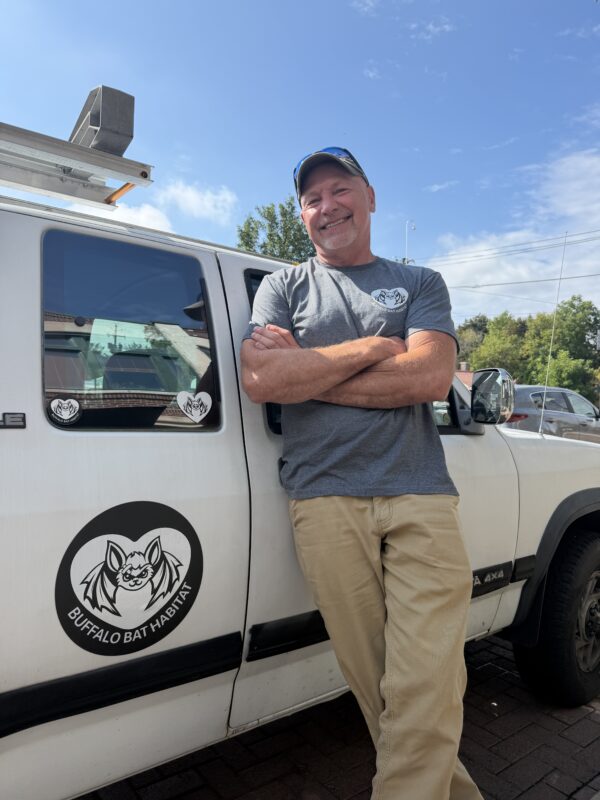
The “Fog Game,” as it was called, was blamed on a lack of air conditioning, but to Brian Caughel, it was the sign of a curse—linked to the bat’s death—that would leave Buffalo without a Cup win ever since.
True or not, that tale has given Caughel, founder of the bat conservation group Buffalo Bat Habitat, a fun hook to help educate people about bats. “I call it the Battered Bat Cup Curse,” Caughel says. “If we help the bats, we can lift the curse and allow the Sabres to finally win the Stanley Cup.”
A bad rap
Caughel, a lifelong naturalist and bat enthusiast, started the advocacy nonprofit in 2024 after learning about their decline. To help raise awareness, he wondered if the “Fog Game” could become something larger.
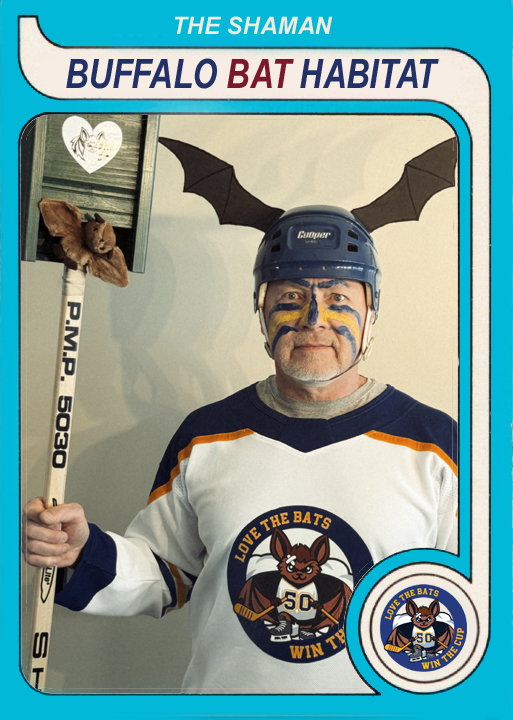
He created a Sabres-jersey-wearing alter-ego, the Buffalo Bat Shaman, to teach people about the bats and help save their habitats.
“Bats get a bad rap, and I saw the Shaman as a fun way to break down the stigma around them,” he says.
Bats are misunderstood creatures often associated with darkness and superstition—and rabies. But these remarkable, non-aggressive mammals play essential roles in natural ecosystems, serving as pollinators, seed dispersers, and natural pest controllers.
According to researchers, only one percent of bats carry rabies, compared to much higher numbers among other wild mammals, like raccoons.
The loss of bats creates a cascading effect throughout an ecosystem. Bats consume enormous numbers of mosquitoes and agricultural pests. One local species, the big brown bat, can potentially control about 250,000 flying insects annually per bat.
According to Buffalo Bat Habitat, WNY bat insect control provides an estimated $20 million in economic services.
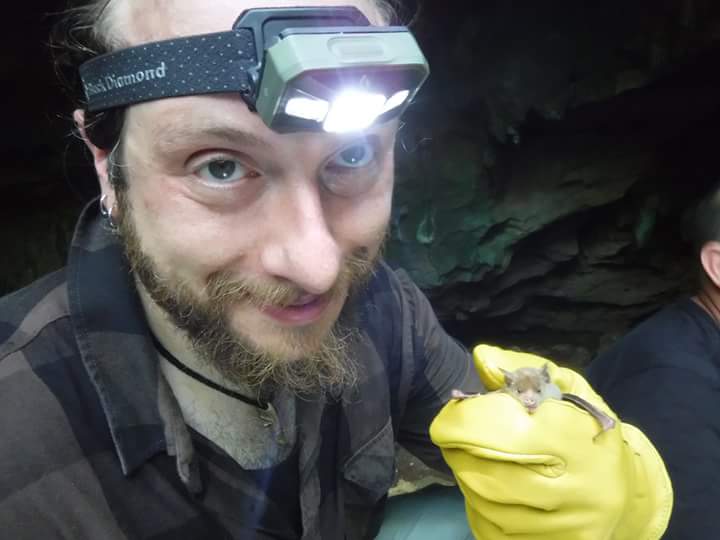
They eat flying adult insects, but they also eat females that are loaded with eggs, says Jonathan Townsend, a local bat scientist and native plant advocate.
“By eating one female mosquito that could have 1000s of eggs inside of her, you’re preventing the release of those larval insects that are attacking the agricultural plants,” Townsend says.
A deadly disease attacks “Chautauqua butterflies”
In the 1990s, Caughel lived in Sodus, NY, where he loved watching bats at dusk with his kids. Now in East Aurora, he and his grandchildren don’t see many bats at all.
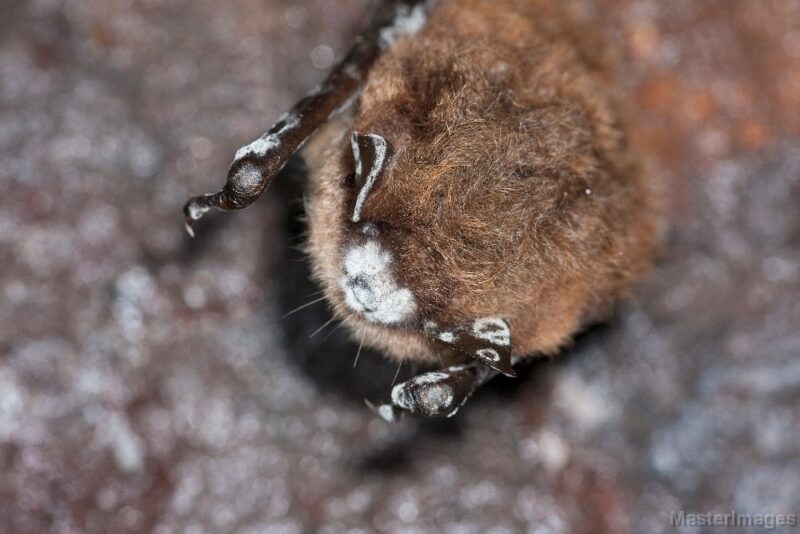
The culprit is a European fungus that causes a condition called white-nose syndrome, which has killed more than 6.7 million bats nationwide since it was discovered in the Albany area in 2006. Scientists believe the fungus was most likely introduced by humans visiting nearby caves. European bats are immune, but several North American species have lost more than 90 percent of their populations, with a 100 percent mortality rate among certain bat colonies.
The fungus, which is not harmful to humans, thrives in cool, dark caves where bats hibernate, forming a white, powdery film on their noses. Not only does the condition wake bats from hibernation in the middle of winter, leaving them vulnerable to cold and starvation, but it also affects their skin and wings, making them prone to other diseases.
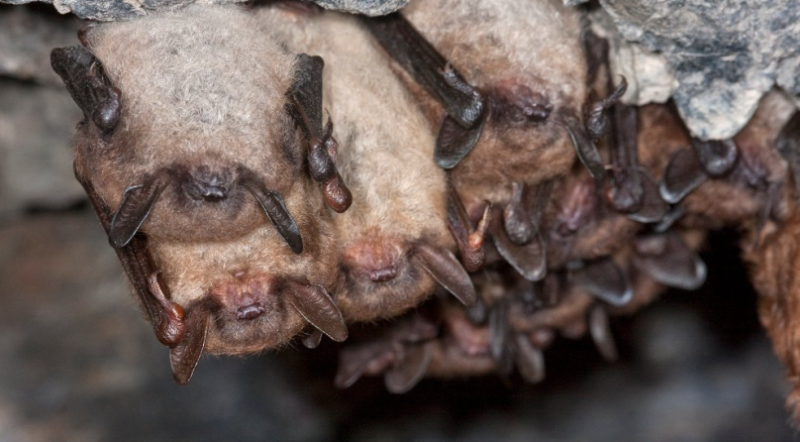
Since it appeared, the fungus has nearly wiped out the little brown bat (myotis lucifugus), one of WNY’s nine local bat species and the most common bats we see (or used to) in the night skies, says Townsend.
Last February, Townsend joined Caughel as volunteer executive director of Buffalo Bat Habitat. Together they’re working to save a threatened maternal bat colony on a farmstead in Ripley, NY, along Lake Erie in Chautauqua County.
Bats love trees, and in the spring and summer, colonies of nursing females will look for forests, caves and even built structures like barns and houses in which to roost and raise offspring.
Any cozy, protected space will work for a bat in need of rest, and then they often move on—if they don’t get trapped. In the winter, bats will migrate up to 150 miles to find a suitable hibernation spot.
In Chautauqua County, Townsend says, there’s unique geography along the Lake Erie shoreline that includes forested land, caves and meadow attractive to bats, so much so that locals refer to them as “Chautauqua butterflies” and have formed local advocacy groups to help protect local bat species. The Chautauqua Institution’s many buildings have hosted bat colonies as well.
The Ripley Bat Farm
The 80-acre property in Ripley includes a farmstead dating back to 1847, now owned by Lew and Dorothy Barnes. At one time it supported close to 2,000 bats, including little browns and big brown bats, but fewer than 40 bats remained in 2017, when Townsend began counting them.
Since then, Townsend has documented emerging bats in Chautauqua County throughout the summer months, and he reports a slow but steady population increase at the farm over the past 10 years.
Townsend speculates on the rebound, saying little brown bats “are kind of changing their behavior, or they’ve got good habitat,” allowing them to survive the syndrome. Another theory is that new genetic adaptations allow them to stay fatter and healthier through the winter.
Now the Barneses need to sell, threatening the colony. Caughel brought Townsend on as volunteer executive director in February 2026, and they set up a board of directors to help guide the creation of a permanent conservation area and nature preserve on the property.
Protecting the recovering maternity colony is the primary goal, says Townsend. The proposed conservation area includes the farm’s homestead and about half a mile of Lake Erie cliffs, as well as a Native American archeological site and separate veterans’ park.
Plans include converting a soybean field, located next to the Ripley site off Route 5, into a pollinator meadow, using native plants with input from regional landscape nurseries.
“Native genetics support insects that form the foundation of the bats’ food chain,” says Townsend.
The Archaeological Conservancy, a national nonprofit, has committed a little over $200,000 toward one of the parcels, which contains a rare Indigenous “earthwork” described as either a fortified village or a ritual site. Caughel and Townsend plan to work with the Conservancy to protect the site and collaborate with local and national Native American tribes to support their cultural interests and respect their ancestral connection to the land.
Buffalo Bat Habitat is also waiting to hear about a $388,000 New York State open-space grant to develop the veterans park and meadow. More private fundraising is needed to help purchase the homestead and turn it into a public visitor and education center.
Caughel and Townsend hope that the Ripley Bat Farm will someday become a fully restored bat conservation preserve and a place of regional pride.
Luci Fest
On October 10, Buffalo Bat Habitat hosts Luci Fest, a fundraiser for the Ripley Bat Farm (named after the little brown, myotis lucifugus) at Elma Village Green in Elma from noon to 5 p.m.
There will be live music, food trucks, and proceeds go to Save the Ripley Bat Farm Fund.

How you can help
Local gardeners can help support bat populations by installing bat houses, maintaining healthy forests and trees, and planting native species. Bats are most active in the spring and summer, so you can contact Caughel for more information on how your garden can host these remarkable creatures, and how and when to remove (exclude) them humanely.
“By providing more habitat and treating bats with respect, we can lift that curse, and help bats do their vital jobs for the environment,” says Caughel.
More resources:
Bat Conservation International’s Guide to Gardening for Bats
Buy a Bat House.
Read more about the bat die-off.