

By Ellen Goldstein
John Farfaglia, horticulture educator at Cornell Cooperative Extension, Niagara County, sat down with Buffalo-NiagaraGardening.com to talk about a deadly new disease threatening local oak trees.
What is oak wilt?
Oak leaf wilt is a plant disease that attacks oak trees. Basically, it is a fungus that shuts off the abilities of the oak trees to transport water from the roots to the branches and leaves. The disease disrupts the water flow in the plant, and it has the potential to kill the tree. Oak wilt is somewhat similar to Dutch elm disease in that they both interfere with the water flow system that keeps the trees alive.

Is it a problem here in Western New York?
Right now, in Erie and Niagara Counties it is not yet a problem, but it has been confirmed as close as Niagara Falls, Ontario, so it is on our border. It has also been found in a few other locations in New York State, including Long Island and two places closer: Ontario County and Yates County, both in the Finger Lakes. However, there are no confirmations here yet, but the likelihood is that oak leaf wilt will show up in Western New York. Currently, the New York State Department of Environmental Conservation (DEC) is monitoring the sites above and watching for any further evidence of more oak wilt spread.
Why do we need to worry about it?
Oaks are an extremely important tree in our ecosystem. They support a great deal of life. The acorns are an important food source for squirrels, deer, and other wildlife. Oaks also support several hundred species of caterpillars, and caterpillars themselves are an important food source for birds. The trees themselves, when fully grown, are very large and stately, providing shade, and helping filter air of pollutants. It would be terrible to lose these trees, and it is important to our environment not to lose them.
What does this tree disease look like?
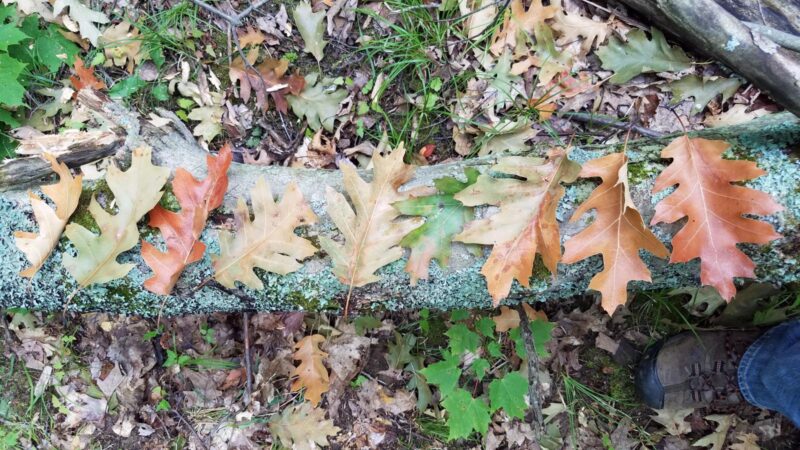
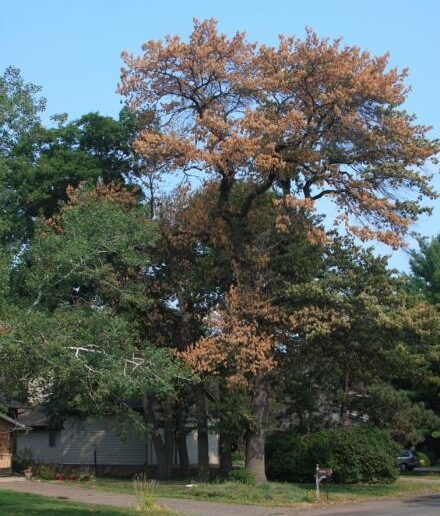
The two major symptoms are browning of the leaves from the tip back towards the center of the leaf. Right now, oak leaves should be green, not brown. The more obvious symptom is the dropping of leaves that have started to brown in the summer, because leaves should not be dropping from an oak tree in the summer.
Typically, if they find a diseased oak, the DEC will remove the tree if it’s a new infestation. Because as the disease progresses, the roots of oak trees can graft together underground, and an infected tree can spread the disease to an uninfected tree.
The disease is spread by roots and by a bark beetle, who is capable of flying and can spread the disease to an uninfected tree. The other issue is that it is recommended not to prune oak trees during the growing season, because the beetle is attracted to tree wounds. Only prune oak trees in the winter months. Finally, firewood should not be transported out of areas where oak wilt is currently present.
What can we do to prevent oak wilt?
There is a treatment which can be used preventatively for high-value trees, of which an oak is one. It is a fungicide that is injected into the trees, (like with emerald ash borer disease in ash trees) and it can only be treated by an arborist. This is most effective when done before the disease has infected the tree. People may want to investigate this as an option. Contact a certified arborist. Do a search for arborists locally, or oak wilt disease, and you are likely to come up with a potential source for help.
- If homeowners do see any signs of this disease in oak trees, they can report it to their local Cornell Cooperative Extension or to the NYS DEC Buffalo Office, 700 Delaware Ave, Buffalo 14209. 716-851-7000.
- For more information, visit this NYSDEC webpage.
- Learn how to prune your oaks properly to prevent disease (PDF).
- And here’s a helpful video, also by the DEC:
Ellen Goldstein is a life-long gardener who raises blossoms, food and herbs in her Elmwood Village neighborhood.

