

by Connie Oswald Stofko
If your neighbors have lesser celandine, you will soon have this horrible, but cute, plant all over your gardens and lawn.
What can you do?
Talk to your neighbors–in a nice way. That’s what Devon Southall of Tonawanda did.
Southall had some lesser celandine in her backyard, so she asked her neighbor if she could check along their shared fence. Yikes! Along the fence, Southall found a carpet of lesser celandine about 75 feet long.
That year, she sent a letter to all her affected neighbors.
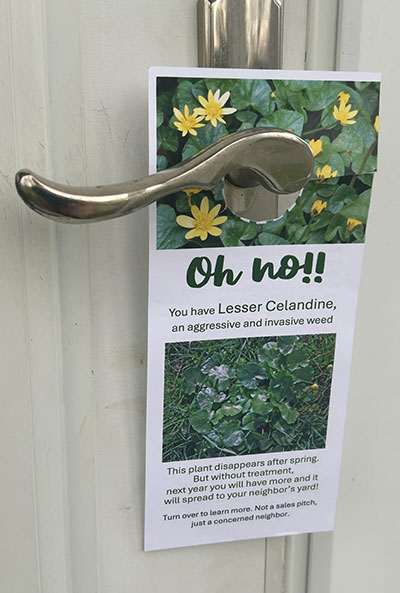
This past year, she made up door hangers for her neighbors. She had them printed on both sides of cardstock, and cut out the hanging hole. That’s the photo you see to the right. I especially love the sentence, “Not a sales pitch, just a concerned neighbor.”
You can do the same thing in your neighborhood.
Southall allows you to copy her door hanger, which even has a space for your name and phone on the back. Her site is Devon’s Nature 360.
Tip: A couple years ago, I made a handout that you can print out and share with neighbors and friends.
When you read Southall’s article, you will notice she uses herbicide. WNY PRISM sees herbicide as an effective control method for lesser celandine, particularly for large infestations. Here are a few more tips on controlling large areas of lesser celandine.
Bonus tip: Southall has started an email list for seasonal alerts on lesser celandine. Sign up here. It includes a signup for a future Citizen Science Project where we can collect others’ experiences with controlling this plant.
Why lesser celandine is a problem
- Lesser celandine can destroy your lawn. This plant can spread and spread until you–literally–have no grass.
- Your gardens aren’t safe, either. The dainty flowers seem harmless, but lesser celandine takes over your gardens.
- It spreads from neighbor to neighbor and beyond. If you see lesser celandine in your neighborhood, it will probably show up in your yard, too. Birds can spread the seeds, too.
- It chokes out native plants in wild areas.

I asked Andrea Locke, coordinator at WNY PRISM, to give us more information on Spectacide Weed & Grass Killer and Weedol.
“I am unfamiliar with either of these products and can’t speak to them directly. I did an online search and was able to find the label for Spectacide but ‘Weedol’ seems to be a brand name that has A LOT of different formulations. Some have glyphosate, some look similar to Spectacide and some look to just be vinegar. The person will need to look at the label that came attached to the bottle and look up the EPA registration number to see if it’s approved for use in NYS. If it doesn’t have an EPA registration number, then it may not be approved for use in the U.S. Though depending on what the active ingredient is, a particular formulation could qualify under the Minimum Risk Pesticides (25(b)) and would not require an EPA registration number. I don’t know anything about import laws regarding things like this and wouldn’t know where to start.
“I would recommend finding a similar product available in the U.S.
“Spectacide Weed & Grass killer is a broad-spectrum herbicide. It includes 3 active ingredients, two of which are used for control of perennials (one for grass and one for broadleaf) while the third is typically used just to “top-kill.”
“People can use the NYS Bureau of Pesticide Management – Information Portal: https://extapps.dec.ny.gov/nyspad/?0 to see if a specific pesticide is approved for use in NYS.”
If I apply Spectacide Weed & Grass Killer in my beds, will it kill the perennials that are in there?
I found a product, Weedol, available in the UK. Studies show it does not cause significant bee mortality. You have to pay shipping but the product goes a long way- after four or five years I am still on my first box of vials. Also in that time I have reduced my yearly infestation of lesser C from giant patches to very little, even though I am surrounded by neighbors’ lawns and an adjacent park all overrun with lesser C. I get out there at the first sign of growth and follow up with another application for the late comers. Use a tank with hose just to target the individual leaves. It does not affect woody plants where lesser C likes to cluster. Good luck!
Thanks for introduction to Devon Southall and and Devon’s Nature 360! Great information!
Yes, it’s that time again! I know it’s lurking under the snow, ready to pop -up and make my life miserable. What’s especially annoying about it is after it blooms it’s apparently too late for herbicides. I’ve tried many “natural/organic” sprays and been disappointed . I’m trying something new this year and I”ll be ready when I see those shiny leaves. I love Devon’s approach to notifying her neighbors, thanks for sharing